
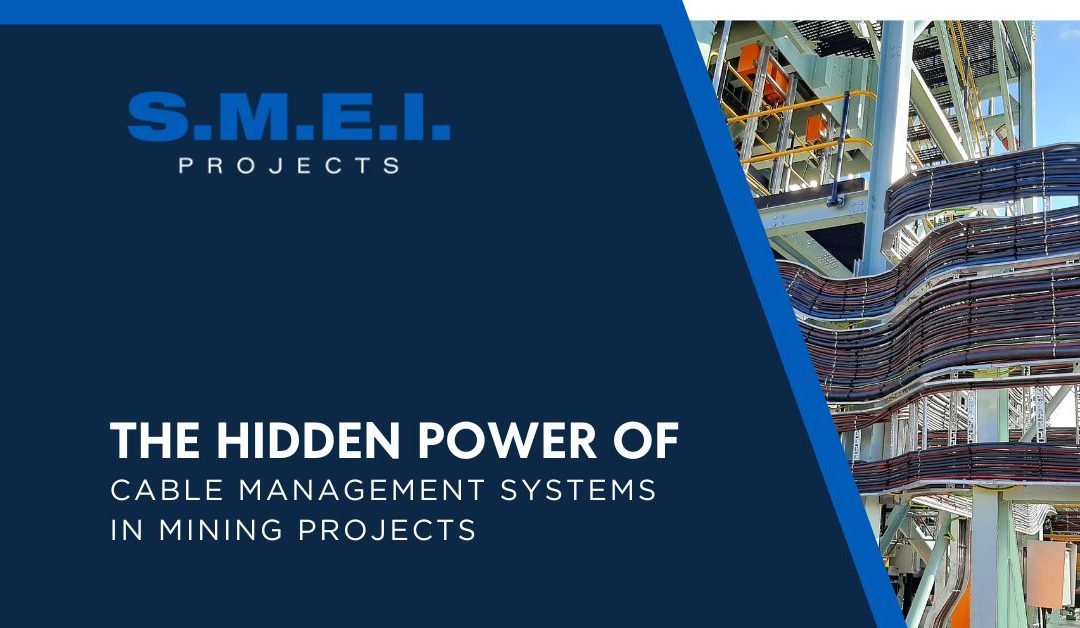
In modern mining operations, electrical and control cabling forms the invisible backbone of productivity. From motor control centres to field instruments, every system depends on the precision, integrity, and traceability of its cables. Yet, despite its importance, cable management remains one of the most overlooked aspects of project execution.
At S.M.E.I. Projects, we’ve learned that good cable management isn’t just about neat routing or tidy trays, it’s about control, accountability, and project efficiency. On large-scale mining projects, where tens of thousands of metres of power, control, and instrumentation cable are installed, effective management can make the difference between staying on schedule or slipping by months.
Why Cable Management Matters in Mining
Mining and heavy industrial projects operate in extreme environments – dust, vibration, heat, and corrosive conditions all impact cable lifespan and performance. Poorly managed cabling can lead to more than inefficiency; it can lead to failure.
A robust cable management system ensures:
- Traceability: Every cable length, type, and termination is tracked from delivery to commissioning.
- Efficiency: Installation progress is measurable, enabling better scheduling and resource allocation.
- Safety: Correct routing, earthing, and segregation prevent overheating and electrical hazards.
- Compliance: Documentation supports SANS standards, client specifications, and QA audits.
Without these controls, even well-engineered projects can fall victim to rework, material loss, and costly downtime.
The Scale of the Challenge
In a typical processing plant, kilometres of cable connect critical assets: switchgear, MCCs, transformers, instrumentation panels, and field devices. Multiply that across multiple plant areas, and the challenge of maintaining oversight becomes immense.
For example:
- A single large mine may install 50,000–100,000 metres of cabling.
- Hundreds of cable types (power, control, communication) must be tracked.
- Thousands of terminations and joints must be tested, tagged, and documented.
Without a formal system, keeping track of what’s been installed, what’s still in storage, and what’s due for testing becomes nearly impossible. This is where S.M.E.I. Projects’ Cable Management System sets a new industry standard.
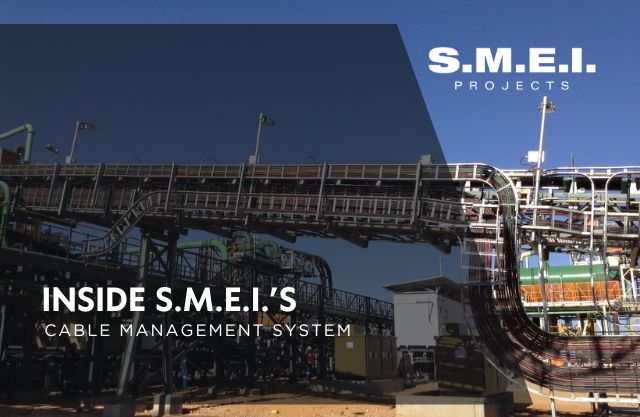
Inside S.M.E.I.’s Cable Management System
Our Cable Management System is a structured, end-to-end tracking process that provides full visibility of cable movement from procurement to commissioning. Designed specifically for large-scale industrial environments, it integrates with our quality assurance and scheduling systems to maintain absolute control throughout the project.
Key Features:
- Cable Tracking:
Every cable is logged with a unique identifier, length, and destination. Installation teams update progress daily, ensuring live reporting against project milestones. - Material Control:
Cable drums in storage are reconciled with installation progress. This allows for early detection of shortages, damaged reels, or incorrect deliveries, long before they cause delays. - Digital Oversight:
The system produces reports showing:
○ Total length installed.
○ Remaining stock in storage.
○ Cables still to be pulled.
○ Cable lengths reserved for critical areas. - Quality Integration:
Each cable record links directly to inspection and testing documentation, ensuring that every installed section has a QA/QC trail from supplier certificate to commissioning report. - Safety and Compliance:
Cable numbering, tagging, and segregation are built into the management process, maintaining clear separation between power, control, and instrumentation cabling as per SANS requirements.
From Planning to Performance: How It Works on Site
When S.M.E.I. Projects mobilises to site, cable management begins immediately.
- Receiving: Cables are offloaded, inspected, and verified against supplier certificates.
- Storage: Each drum is labelled and logged in the cable management register.
- Installation: As installation progresses, crews record cable numbers, routes, and lengths installed.
- Testing: Completed circuits undergo insulation resistance and continuity testing, with results logged under their unique identifier.
- Commissioning: Final verification links every cable to its test and sign-off record, ensuring total traceability.
This disciplined process not only guarantees compliance, it eliminates the guesswork that often causes project delays and cost overruns.
Best Practices for Cable Integrity and Safety
A great cable management system is only as effective as the installation practices behind it. Our teams follow international best practice and SANS standards to ensure durability, performance, and safety.
1. Proper Routing and Support
Cables are routed on racking, trays, or conduits with adequate spacing to avoid interference and overheating.
2. Correct Bending Radius and Strain Relief
Excessive bending can damage insulation and affect conductivity. All terminations include proper strain relief to maintain integrity under vibration.
3. Earthing and Bonding
All metallic cable supports, racks, and trays are properly bonded to the plant’s earth system, minimising fault current risk.
4. Segregation by Function
Power, control, and instrumentation cables are installed with adequate separation to prevent electromagnetic interference.
5. Cable Identification and Tagging
Each cable is labelled according to the project’s numbering system, ensuring quick fault-finding and long-term maintenance efficiency.
These principles, combined with SMEI’s structured management system, ensure reliability far beyond the handover stage.
Integrating Cable Management with Project Controls
At S.M.E.I. Projects, cable management is not a standalone activity, it’s integrated directly into construction management, scheduling, and reporting systems.
Our project managers use cable data to forecast daily targets, validate progress claims, and coordinate with other disciplines such as mechanical or civil teams.
This ensures the entire project ecosystem moves forward in sync, reducing idle time and improving productivity.
By embedding cable management within the wider EC&I and SMPP frameworks, SMEI delivers both operational transparency and measurable performance.
The Long-Term Value of Doing It Right
A disciplined cable management process continues to deliver value long after project completion:
- Maintenance teams benefit from accurate as-built documentation.
- Faults can be traced and isolated quickly.
- Expansion or retrofit projects are simpler, thanks to existing cable traceability.
For clients, this translates to lower lifecycle costs, reduced unplanned downtime, and a more resilient electrical infrastructure.
Conclusion: Turning Order into Efficiency
In the fast-paced world of mining construction, cables may not be the most visible components, but they’re among the most vital.
A well-managed cable system represents order, discipline, and foresight, qualities that define S.M.E.I. Projects’ approach to every EC&I contract.
By integrating digital tracking, field supervision, and quality control into a single cable management framework, we ensure that every metre installed contributes to project precision and long-term reliability.
S.M.E.I. Projects: powering Africa’s progress, one perfectly managed cable at a time.