

Mineral processing plant case study: As Africa’s mining industry continues to mature, the ability to fabricate and deliver full turnkey mineral processing plants has become a defining advantage for contractors on the continent. These complex projects demand not only technical excellence but seamless coordination across supply chains, engineering disciplines, and geographies.
This case study highlights a recent mid-tier gold project in West Africa, where rapid progress, strong partnerships, and modular thinking converged to fast-track plant delivery under demanding conditions.
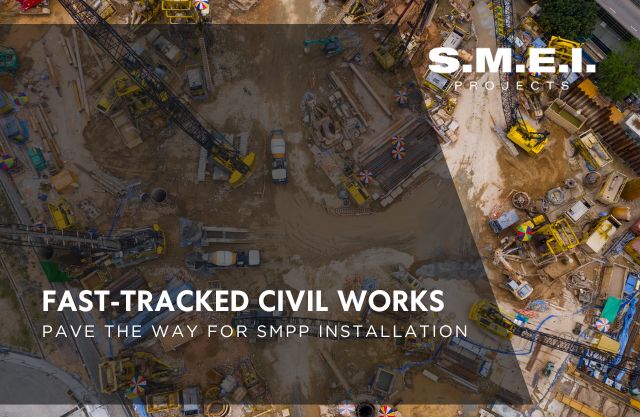
Fast-Tracked Civil Works Pave the Way for SMPP Installation
By Q4 2024, over 90% of civil works were complete on-site — a significant milestone that enabled the Structural, Mechanical, Platework, and Piping (SMPP) team to mobilise without delay. This approach of parallel progress, where civils and plant packages advance simultaneously, is becoming best practice in fast-tracked mining developments.
Contractors who specialise in SMPP — such as S.M.E.I. Projects — depend on accurate sequencing and precise civil interfaces to install critical infrastructure like:
- Crushing and milling circuits
- Conveyor systems
- Structural steel frameworks
- Tanks, chutes, and process piping
In this case, early civil completion allowed SMPP teams to begin steel erection and equipment installation promptly, shaving weeks off the total project schedule.
Prefabricated Modules Streamline Logistics and Installation
To minimise on-site work and speed up delivery, over 160 truckloads of prefabricated plant components — including crushers, mills, and structural steel — were delivered via port within weeks. These modules were fabricated off-site in controlled environments, improving quality assurance and simplifying assembly on-site.
Modular delivery offered key benefits:
- Reduced site fabrication time
- Improved quality control on welds and fittings
- Faster commissioning, with critical-path items arriving in installation-ready condition
For mining projects located in remote areas with limited fabrication infrastructure, this method significantly reduces risk and delays — especially during the rainy season, when on-site welding and lifting become more difficult.
Overcoming Weather and Logistical Challenges
Despite heavy rains and complex cross-border logistics, the project maintained momentum, slipping just a few weeks behind its initial schedule. First gold production remained on track for Q1 2025, thanks to disciplined project management and local partner alignment.
Key to this resilience was:
- Advanced route planning and customs clearance for oversized cargo
- Local sourcing of support materials to reduce transport dependencies
- Regular alignment between engineering, logistics, and construction teams
This level of coordination shows that, with the right team and approach, African-based contractors can deliver globally competitive outcomes in even the most challenging conditions.

South African Expertise: Built for Global Standards
This project reflects a broader trend: African contractors — particularly from South Africa — are delivering high-spec mining infrastructure across the continent and beyond.
In one notable example outside Africa, a Chilean copper mine expansion required fabricated steelwork to comply with strict seismic design codes. South African fabricators rose to the challenge, delivering fully compliant modules to international standards — a clear demonstration of capability and trust.
As SAISC CEO Amanuel Gebremeskel stated:
“Our local fabricators have forged ahead… delivering products and innovations never seen before.”
(miningbusinessafrica.co.za)
This ability to meet stringent global benchmarks while maintaining cost competitiveness is placing South African SMPP contractors in high demand across Africa and internationally.
Why This Matters: Lessons for Future Projects
This mineral processing plant case study showcases the real-world benefits of:
- Early civil and SMPP integration
- Prefabricated modular delivery
- Collaborative project management
- Leveraging local African expertise to global standards
For project owners, the message is clear: African contractors are not only capable of delivering full turnkey plants — they are redefining what’s possible under pressure.
Looking to partner with a contractor who delivers results under pressure? S.M.E.I. Projects offers turnkey solutions for mineral processing plants across Africa – engineered with precision, delivered with pride.
You May Also Like
Project Showcase: Constructing a Turnkey Processing Plant in Africa
Mineral processing plant case study: As Africa’s mining industry continues to mature, the ability to fabricate and deliver
 July 22, 2025
Industry Insight: Trends in African Mining Infrastructure Development (2025)
Mining has long been a cornerstone of Africa’s economic development — but in 2025, it is clearer thanJune 18, 2025
Efficient Piping Systems for Mines and Infrastructure
In Africa’s mining sector, efficiency isn’t just a goal – it’s a lifeline. Piping systems, often the hidden June 18, 2025
Platework Fabrication in Mining: Tanks, Chutes, and Ducting Excellence
Platework fabrication is the backbone of many mining infrastructure components, including storage tanks, ore chutes, bins, and large May 27, 2025
Heavy Mechanical Equipment Installation Challenges in Mining Sites
In the demanding environments of mining across Africa, structural steel is more than just a building material –
Transport Corridors: Connecting Mines to Global Markets
To unlock landlocked mineral-rich regions, African governments and development finance institutions are prioritising transport corridors that facilitate exports and encourage local value-addition.
One of the most prominent is the Lobito Corridor, linking Zambia’s Copperbelt and the Democratic Republic of Congo to the Angolan port of Lobito on the Atlantic coast. By offering a faster and more reliable export route, this corridor is set to reduce logistics costs, boost export volumes, and support local processing industries along the route.
Other strategic corridors include:
- Maputo Development Corridor (South Africa–Mozambique)
- Nacala Corridor (Malawi–Mozambique)
- TAZARA Rail Upgrades (Tanzania–Zambia–DRC)
These multi-use corridors are paving the way for regional integration, with mining at the centre of economic transformation.