
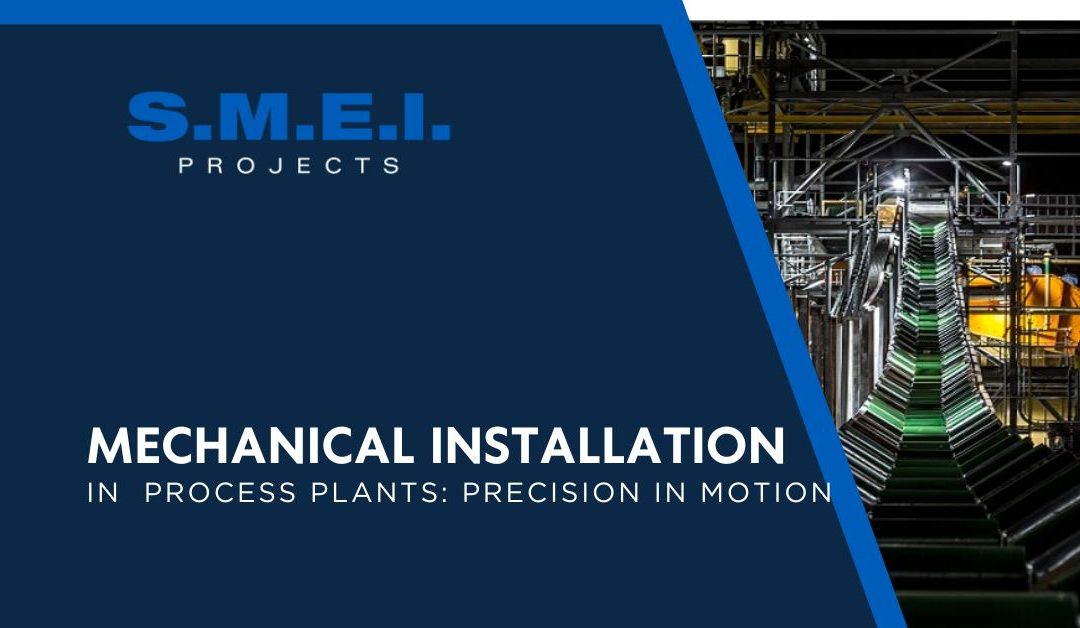
Every ton of ore processed, every drop of slurry moved, and every grain of concentrate produced depends on the reliable performance of mechanical equipment. In mining and heavy industrial operations, these machines, crushers, mills, thickeners, conveyors, pumps, and agitators, form the beating heart of the plant.
But even the most advanced machinery only performs as well as it’s installed. Precision in mechanical equipment installation is what turns engineered designs into operational reality. At S.M.E.I. Projects, mechanical installation is both an art and a science, executed through disciplined methodology, skilled supervision, and a commitment to quality that defines our reputation across Africa’s mining sector.
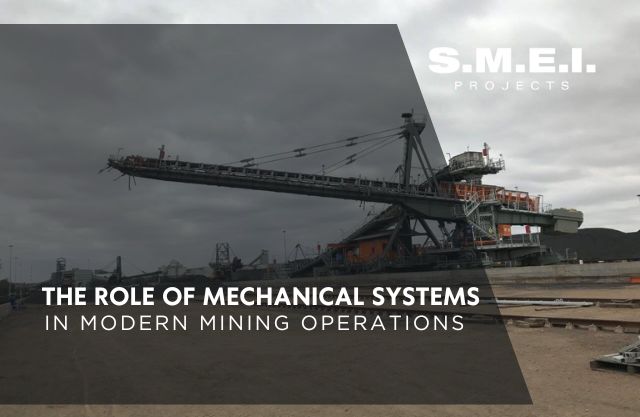
The Role of Mechanical Systems in Modern Mining Operations
Mechanical equipment enables every process stage in a mine, from primary crushing to flotation, filtering, and concentrate handling. Its proper installation determines:
- Efficiency: Whether systems operate at design throughput and energy efficiency.
- Reliability: How long components last before requiring maintenance.
- Safety: The stability of rotating and load-bearing equipment under stress.
- Performance: The accuracy of alignment between connected systems like piping, conveyors, and motors.
In large-scale projects, even minor misalignments, a few millimetres off at base level, can lead to premature bearing wear, vibration, and production losses. That’s why S.M.E.I. Projects applies rigorous mechanical standards to every project, ensuring that once equipment starts running, it stays running.
From Delivery to Commissioning: The SMEI Installation Process
Mechanical installation is a multi-stage discipline that demands coordination between engineering, rigging, welding, electrical, and QA teams.
1. Planning and Preparation
Before the first lift, our teams prepare detailed method statements, lifting plans, and risk assessments. Each equipment foundation, baseplate, and anchor point is surveyed and verified for level and alignment.
2. Rigging and Positioning
Large mechanical components, mills, crushers, thickeners, agitators, require heavy lifts with millimetre precision. S.M.E.I. Projects’ rigging teams use certified cranes, spreader beams, and laser alignment tools to position equipment safely and accurately, following pre-approved lift studies.
3. Installation and Alignment
Once in place, mechanical assemblies are secured using calibrated torque tools and precision shimming techniques. We use laser alignment and dial indicator systems to achieve tolerances as fine as ±0.05 mm, critical for rotating machinery such as pump sets and gearboxes.
4. Coupling and Integration
Our mechanical teams work hand-in-hand with piping and EC&I divisions to ensure that couplings, drive connections, and instrumentation align perfectly. This integration avoids clashes and ensures efficient commissioning.
5. Testing and Commissioning Support
Before handover, we conduct mechanical run tests, rotation checks, and vibration analyses, ensuring all equipment meets OEM requirements. Our teams assist vendors during cold and hot commissioning, providing field support until performance criteria are achieved.
Safety as the Core of Mechanical Work
Mechanical installation involves some of the most complex and high-risk activities on a construction site, heavy lifts, confined spaces, working at heights, and energy isolation.
S.M.E.I. Projects enforces strict Safety, Health, and Environmental (SHE) procedures to ensure that every activity is executed safely.
This includes:
- Detailed lift plans signed off by qualified engineers.
- Permit-to-work and lock-out systems during mechanical integration.
- Trained riggers, fitters, and mechanical supervisors with valid certifications.
- Daily toolbox talks and job hazard analysis before every shift.
The result is a culture of accountability and precision, because safety and performance are inseparable in high-stakes mechanical work.
Working with OEMs and Vendors
Collaboration with Original Equipment Manufacturers (OEMs) is central to successful mechanical installation. Each piece of equipment comes with unique design parameters, torque values, and alignment specifications.
S.M.E.I. Projects coordinates closely with vendor representatives throughout the process:
- Providing installation assistance and supervision during assembly.
- Ensuring all OEM specifications are followed and documented.
- Supporting vendor commissioning and final acceptance testing.
This partnership approach ensures that equipment is not only installed correctly but performs exactly as designed under real-world operating conditions.
Quality Assurance and Control
In mechanical installation, documentation is as important as precision.
Every step is verified, inspected, and signed off through formal Inspection and Test Plans (ITPs) covering:
- Bolt torque verification.
- Alignment and levelling records.
- Weld inspection and NDT (Non-Destructive Testing) results.
- Lubrication and hydraulic pressure tests.
- Functional run checks.
Our quality team ensures full traceability from fabrication to final commissioning, giving clients confidence that every installation meets both SANS and OEM standards.
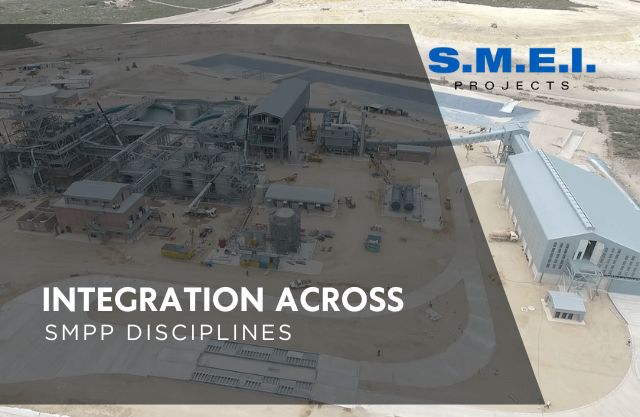
Integration Across SMPP Disciplines
Mechanical installation never happens in isolation, it’s deeply interlinked with structural supports, platework connections, and piping systems. By handling SMPP as one integrated scope, S.M.E.I. Projects eliminates the common delays caused by cross-discipline misalignment.
Our structural teams ensure accurate foundation and support steel placement. Our platework fabricators deliver chutes and tanks ready for mechanical connection. Our piping division ties in systems efficiently for hydrotesting and commissioning.
This seamless coordination allows all disciplines to progress in parallel, compressing timelines and maintaining consistent quality throughout.
Why Precision Matters
Mechanical installation is about more than bolts and bearings, it’s about trust.
Every rotation, every vibration, and every movement within a processing plant depends on the accuracy of that installation. When equipment operates with perfect balance and alignment, energy efficiency improves, downtime decreases, and total lifecycle cost drops.
Precision installation is the difference between a plant that runs for years and one that stops every quarter for unplanned maintenance.
Conclusion: Engineering Motion with Confidence
At S.M.E.I. Projects, we understand that mechanical systems are the pulse of every mine.
Our teams bring the technical expertise, precision tools, and disciplined processes needed to install equipment that performs flawlessly, under the toughest African conditions.
From heavy mill assemblies to intricate conveyor systems, we combine structural integrity, mechanical precision, and quality control to keep production moving, safely and efficiently.
S.M.E.I. Projects, precision in motion, powering Africa’s industrial future.
Sources: