
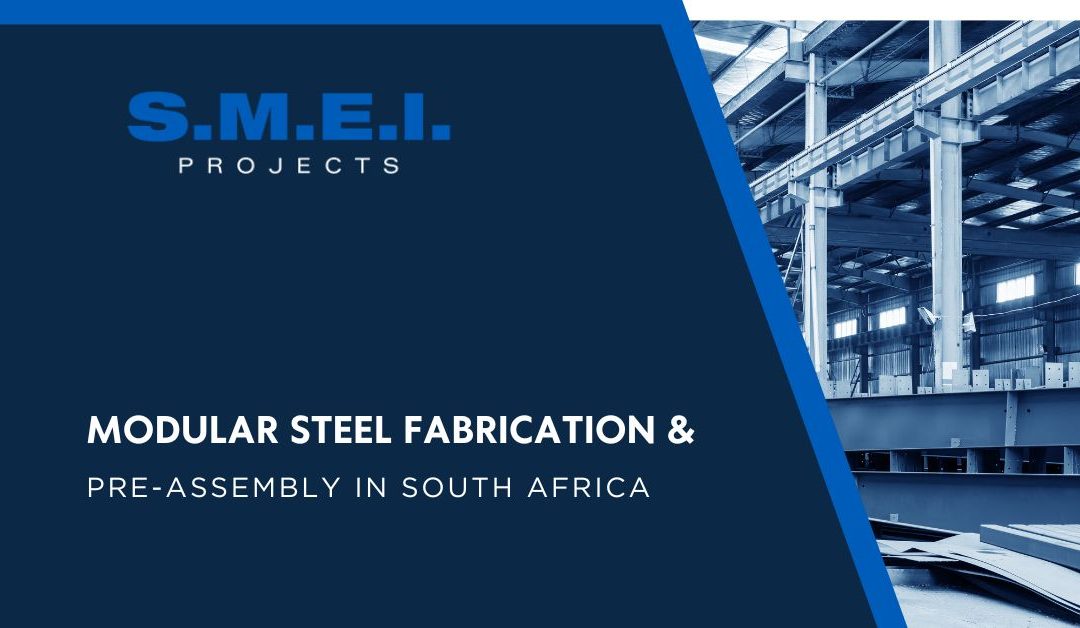
Modular steel fabrication and pre-assembly are increasingly important in Southern African mining, energy and process-industrial projects. Clients and EPC/EPCM teams are looking for ways to reduce site work, improve installation readiness, manage remote-site constraints and bring fabricated steel to site in a more controlled condition. When planned correctly, modular fabrication can support programme efficiency, reduce site interface risk and improve the quality of work completed before mobilisation.
The challenge is not only whether a supplier can fabricate steel. The challenge is whether the supplier has the infrastructure, systems and operational discipline to manage modular work from drawing release through fabrication, trial assembly, corrosion protection coordination, dispatch planning and site installation. Modular work requires workshop capacity, laydown space, lifting and handling resources, transport planning, QA/QC controls and reliable tracking of components through each stage of the workflow.
S.M.E.I. Projects supports this requirement through its Boksburg-based fabrication and project execution environment, combining workshop fabrication, model-based coordination, STRUMIS-supported tracking, expediting, plant and equipment controls, transport coordination and site installation capability under one accountable management structureFew facilities in Southern Africa have consolidated this combination under one management.
What modular fabrication and pre-assembly actually involves
Modular work is not just fabricating larger steel sections. It involves planning, fabricating and pre-assembling functional sections of work before they leave the facility, so the site receives components or modules that are closer to installation readiness. Depending on the project scope and design, modular or pre-assembled work may include:
- Structural steel platforms, modular floors, access steel, grating, handrailing and stair assemblies.
- Pre-assembled piping supports, pipe racks, skids or structural bases where required by the project design.
- Electrical, instrumentation or control-related support structures and enclosures, where applicable to the project scope.
- Conveyor-related structures, transfer towers, gantries, access platforms and associated support steel.
- Tank and silo platforms: access steel, ringbeams and structural support pre-assembled around tank dimensions, where pre-assembly is practical.
- Multi-discipline assemblies where structural steel, platework, piping, mechanical supports and EC&I interfaces can be coordinated before site installation.
The operational complexity lies in coordinating multiple workfaces in parallel. Each module or pre-assembled section may have its own drawing release status, fabrication route, fit-up requirements, inspection points, corrosion protection requirements, dispatch constraints and site installation sequence. S.M.E.I.’s value lies in managing those interfaces through structured planning, expediting, QA/QC controls, dispatch coordination and site execution knowledge.
Why modular and pre-assembly methods support industrial project delivery
For mining and industrial operations in remote locations across Southern Africa, modular delivery has shifted from a value-add to an expectation. Several drivers explain the change.
Reduced site labour and mobilisation pressure
Remote construction sites carry additional cost and complexity, including accommodation, transport, supervision, site access, safety controls and workforce mobilisation. Where work can be completed in a controlled workshop or pre-assembly environment, the site team can focus more effectively on installation and commissioning priorities.
Improved programme coordination
Modular and pre-assembly workflows can allow fabrication, civil works, corrosion protection and installation planning to progress in parallel. This supports improved programme coordination and can reduce the risk of sequential delays where activities wait for site access before work can begin.
Improved quality control in a controlled environment
Workshop and yard-based fabrication allows inspection, fit-up checks and dimensional verification to be completed under more controlled conditions than remote site work. Quality controls should be applied in accordance with approved project specifications, ITPs, applicable standards and S.M.E.I. QA/QC procedures.
Potential reduction in total project interface cost
Modular fabrication can reduce avoidable interface cost when it is planned correctly. The value comes from reduced site congestion, fewer site-based fit-up issues, improved sequence control, earlier identification of clashes and better alignment between fabrication output and installation readiness.
Procurement teams increasingly evaluate execution capability
EPC/EPCM contractors and end clients increasingly assess whether fabrication partners have the systems, equipment, safety controls and management capability to support modular or pre-assembled scopes. This makes execution credibility as important as fabrication capacity.
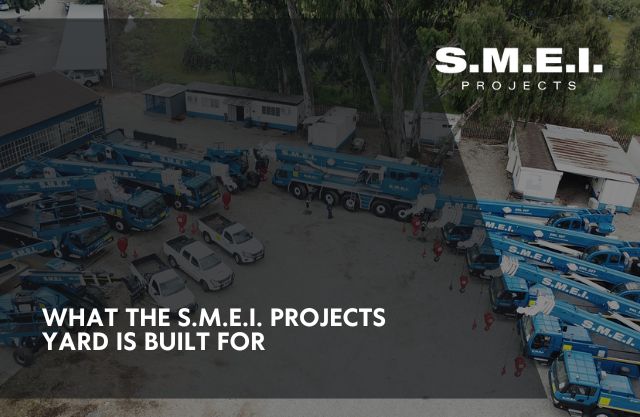
What the S.M.E.I. Projects yard is built for
Pre-assembly requires space, lifting and handling capacity, equipment control, QA/QC systems, expediting discipline, dispatch planning and site installation knowledge. S.M.E.I.’s model is best understood as an integrated project-control environment rather than a list of assets only.
Facility and laydown capacity
S.M.E.I.’s Boksburg facility provides workshop and laydown capacity to support fabrication, trial assembly, staging and dispatch planning and workshop bays for parallel fabrication
Four fabrication bays served by overhead travelling cranes allow structural, plate and assembly work to run simultaneously rather than in sequence. Module sub-assemblies can be fabricated in one bay while finished modules are loaded out of another.
Lifting and handling coverage
The laydown yard is served by owned tower-crane and mobile-crane lifting capacity for module handling, supported by telehandlers for the day-to-day movement of sub-assemblies and modules under construction. Lifting and handling requirements are planned according to module size, weight, configuration and site requirements. S.M.E.I. uses approved lifting equipment, plant resources and competent operators in accordance with project-specific risk controls, lift planning requirements and client safety expectations.
Precision equipment
The fabrication workflow is supported by cutting, drilling, coping, welding and component identification equipment. This assists with dimensional accuracy, repeatability, fabrication control and traceability through the modular assembly process.Corrosion protection coordination and expediting
Painting, galvanising and other corrosion protection requirements must remain connected to the fabrication and dispatch plan. S.M.E.I. manages this interface through experienced expediting and material control processes., supporting status visibility while work is in progress rather than only updating records when items return to the yard.
Dispatch and delivery coordination
A large owned fleet — including horse-and-trailer rigs and Hiab trucks — under one management. The same team that plans module assembly plans module dispatch. There is no transfer of responsibility at the yard gate. The integration point is control. Workshop fabrication, corrosion protection coordination, expediting, QA/QC, dispatch planning, load documentation, plant safety controls and site installation knowledge must work together. S.M.E.I.’s modular offering is therefore positioned around accountability across the full fabrication-to-site chain, not only workshop capacity.
How modular work flows through S.M.E.I.’s controlled execution model
Modular work should be managed through a controlled workflow that supports visibility, traceability and reporting. STRUMIS can support fabrication tracking, progress visibility and reporting across key stages, depending on project setup, scope requirements and agreed reporting controls.1. Drawing-office and model coordination
Our in-house drawing office coordinate with client engineers early in the design cycle to settle transport constraints, lift points, and module break-points before fabrication begins. Decisions about how a module will be transported are designed in, not retrofitted.
2. Component fabrication
Cutting, drilling, welding, and primary inspection are completed in the workshop under QA oversight,
3. Sub-module assembly
Components are assembled into sub-modules with fit-up verification and intermediate quality checks. Discipline-specific subcontractors (instrumentation, specialist mechanical, NDT) integrate into the same scan chain.
4. Trial assembly in the laydown yard
Before dispatch, modules are trial-assembled in the laydown yard for dimensional verification and functional testing. Site-difficult issues, interface mismatches, hidden tolerances, missed components, are caught at this stage, where rectification is cheaper, faster, and within our own control.
5. Corrosion protection and expediting
Corrosion protection — galvanising, painting or specialist coatings — is coordinated with expediting and material control. Protected steel is tracked progressively through the relevant facilities so that status remains visible while the work is in progress.
6. Disassembly and shipment planning
Where transport limits, route constraints or site access requirements apply, modules may be disassembled into manageable sections for shipment. Load planning should consider protection, tie-down requirements, lifting points, delivery sequence and traceability between each sub-module and the parent assembly.
7. Dispatch aligned to the site programme
Loads should be dispatched in line with the site installation programme, access requirements and readiness of the receiving team. The required load, dispatch and compliance documentation must be aligned to each delivery.
8. Site re-assembly and installation readiness
Where S.M.E.I. is responsible for installation, the site team receives fabricated components or modules with the relevant dispatch records, load documentation and supporting QA/QC records. Where the client or another contractor installs the work, the same principle applies: site receipt must be supported by clear documentation, traceability and installation-ready information.
Where modular projects typically fail, and how we prevent it
Modular projects usually lose value when the interfaces between design, fabrication, corrosion protection, dispatch and site installation are not properly managed. For example:
Late material visibility
Modular work requires early material visibility, because one missing component can delay a full assembly.
Specialist and corrosion protection coordination
Specialist services — corrosion protection, NDT, machining and EC&I interfaces — must remain visible within the project control process. S.M.E.I.’s expediting team and material controllers support this by monitoring progress, tracking steel progressively at corrosion protection facilities and ensuring that status updates support fabrication, dispatch and installation planning.
Skipping trial assembly where dimensional risk exists
Trial assembly should be applied where the scope, geometry or interface risk warrants it. The purpose is to identify fit-up or alignment issues before the module reaches site, reducing the risk of costly field rectification. The real insight from years of modular delivery is that the operational disciplines — drawing control, procurement visibility, sequencing, subcontractor coordination, traceability — are not secondary to fabrication. They are the fabrication. They separate a module that arrives ready to install from one that arrives ready to create problems.
Quality and safety: one system across yard and site
Every fabricated module or pre-assembled section must be managed through applicable QA/QC, SHEQ, plant and site safety controls. This includes fabrication inspections, lifting and handling controls, equipment approval, operator competence and client-specific site access requirements.
- Lifting and rigging activities planned according to module weight, configuration, risk assessment, method statement and project requirements.
- Non-Destructive Testing (NDT) on critical welds, scoped per the project Inspection and Test Plan.
- Coating inspections for thickness, adhesion and finish recorded against batch.
- Dimensional verification by laser measurement where the module geometry demands it.
- Full QA documentation linked to each component barcode and consolidated at module level.
Plant and equipment controls should also be included. Equipment is certified, checked daily before use and maintained by dedicated mechanics at S.M.E.I.’s facility. Where plant, trucks or lifting equipment are required on client sites, they must be approved in line with the client’s safety requirements. S.M.E.I. uses trained and authorised operators, with regular training and site inspections by the vehicle coordinator to support safe, compliant equipment use.
Modular capacity is project-driven, not fixed
A common client question is: “What modular capacity can S.M.E.I. support?” The correct answer is that modular output is project-driven. Fabrication and pre-assembly throughput depend on scope, drawing release, material availability, corrosion protection requirements, QA/QC hold points, lifting requirements, site priorities, resource allocation, logistics constraints and approved subcontractor support where required.
What can be pointed to is the operational structure to handle scaling: a workshop set up for parallel module fabrication, a laydown yard sized for parallel assembly and trial fit, a tracking system that maintains control as volume increases, an internal fleet that can dispatch in the required sequence, and a 25-year track record of delivering against industrial scope. For clients, that means modular capacity is not a constraint to design around, it is a parameter to be planned together based on the specific project programme and demand profile.
Supporting more controlled and sustainable project delivery
Modular fabrication can support sustainability and ESG objectives when it reduces unnecessary site activity, improves planning, supports better waste segregation and allows more controlled resource use in a workshop environment. These benefits should be positioned as potential project advantages, subject to the project scope and reporting requirements.
What sets the S.M.E.I. Projects modular offering apart
S.M.E.I.’s modular advantage is not a single asset or a marketing statement. It is the ability to connect fabrication, model coordination, corrosion protection expediting, QA/QC, plant safety controls, dispatch planning, load documentation and site installation under one accountable execution model. For mining, industrial, SMPP, EC&I and renewables clients, this provides a more controlled route from fabricated steel to installation-ready work on site.